

What is Sleeve Anchor
Sleeve anchors, also known as expansion anchors, are mechanical fasteners used to attach objects to concrete, brick, or masonry surfaces. They consist of a cylindrical sleeve, a threaded stud, and a nut and washer. The sleeve is typically made of metal, such as steel or stainless steel, and features evenly spaced longitudinal slots along its length. This design enables the sleeve to expand when the nut is tightened, creating a secure connection with the base material.
Benefits of Sleeve Anchor
Versatility
Sleeve anchors can be used in a variety of concrete and masonry applications and are suitable for both indoor and outdoor use.
Easy installation
Sleeve anchors are relatively easy to install and can be done with simple tools like a drill and a wrench.
Adjustable
The position of the anchor can be adjusted after installation by turning the rod or stud.
Strong holding power
Sleeve anchors provide a strong and secure hold in concrete and masonry, and are suitable for heavy loads.
Variety of head styles
Sleeve anchors come in a variety of head styles, such as hex, acorn, and flat, to suit the specific application and aesthetic requirements.
Variety of sizes and materials
Sleeve anchors come in a range of sizes, and are made of different materials such as zinc-plated carbon steel, stainless steel, and hot-dipped galvanized steel.
Cost-effective
Sleeve anchors are relatively inexpensive and cost-effective for a wide range of applications.
Easy to remove
Sleeve anchors can be removed from the concrete or masonry by unscrewing the rod or stud.


Why Choose Us
Professional team
We have a team of skilled and experienced professionals who are well-versed in the latest technology and industry standards. Our team is dedicated to ensuring that our customers get the best service and support possible.
Competitive prices
We offer our products at competitive prices, making them affordable for our customers. We believe that high-quality products should not come at a premium, and we strive to make our products accessible to all.
Efficient and convenient
The company has established marketing networks around the world to provide high-quality services to customers in an efficient and convenient manner.
Quality assurance
In terms of quality assurance, the company strictly follows the standards and norms of the industry quality system. Adopt industry-leading testing equipment to ensure product quality and good reputation.
High quality products
We always put customer needs and expectations in the first place, refine on, continuous improvement, to seek every opportunity to do better, to provide customers with their expectations of quality products, to provide customers with the most satisfactory service at anytime.
Customer satisfaction
Providing after-sales services can enhance customer satisfaction by ensuring that customers' needs are met even after the purchase. This can lead to increased customer loyalty and positive word-of-mouth referrals.
Sleeve Anchors 5 Things You Should Know
Forgetting to clean the hole prior to the insertion
The importance of cleaning the hole before installing the sleeve anchor cannot be stressed enough. Not only is this step critical for a proper installation, but it is also a guarantee that the anchor will have a maximum holding value. Therefore, do not forget to prepare the insertion spot by removing all potential dust and debris with a wire brush, a vacuum or a compressed air tool.
Inadequate installation
In case you did not know, the strong bond between the part and the concrete is ensured by friction. The key to making sure you get a solid bond between the material and the sleeve anchors implies drilling a hole of the right diameter and depth. In the event that the hole is too deep or too wide, then there is a fair chance the anchor will come loose in time and that could lead to serious injuries. In addition to planning all the details before actually drilling the hole, you should also consider applying a small amount of epoxy to hold the anchors in place.
Utilizing the wrong type of anchor bolt
While they go by the name of sleeve anchors, keep in mind that there are various categories available, designed for different applications. The cast-in-place bolt is widely used in projects that involve fastening items in concrete due to its special design. Simply put, the head is especially created for a secure and full insertion into concrete, while the thread is left out, making it easier to connect other objects with it.
Confusing concrete with a different construction material
Even though the sleeve anchors are a great choice for concrete, it is necessary to underline that they are not a universal tool and may not be as efficient when utilized in conjunction with another material. To put it simply, if you decide to use them with a brick and block base for instance, then there is a fair chance they will damage that surface.
Disregarding the safety standards
Irrespective of the type of project in which you need to use the sleeve anchors, do not forget to read and respect the safety standards, a piece of information you can get from the product description. If you choose to disregard the recommendations on load, spacing or embedment, then keep in mind that it could lead to serious injuries and death because the structure may not be able to withstand a natural disaster or a calamity.
Sleeve Anchor vs. Wedge Anchor: Key Differences
When it comes to anchors, two popular options are sleeve anchors and wedge anchors. While both can be used to secure objects to multiple surfaces, sleeve anchors are generally used for lighter applications such as attaching items to drywall. Wedge anchors, on the other hand, find their primary application in making structural connections in concrete and steel:
How they work
Sleeve anchors work by expanding against the base material, while wedge anchors provide their holding power by compressing the base material.
Strength
Wedge anchors are generally stronger than sleeve anchors and are better suited for heavy-duty applications.
Installation
Sleeve anchors are easier to install than wedge anchors and require less drilling depth.
Base material
Sleeve anchors work well in a variety of base materials, including drywall, brick, and block. Wedge anchors, on the other hand, are best used in solid concrete.
Types of Sleeve Anchors
There are several types of sleeve anchors available, each designed for specific applications and base materials:
Standard Sleeve Anchors
These are the most common type of sleeve anchors, suitable for use in concrete, brick, and block.
Hex Nut Sleeve Anchors
Featuring a hexagonal nut, these anchors provide enhanced torque resistance and are ideal for heavy-duty applications.
Acorn Nut Sleeve Anchors
These anchors come with an acorn nut, which provides a finished appearance and protects the threads from damage.
Flat Head Sleeve Anchors
Designed with a flat head, these anchors are suitable for applications where a flush finish is desired.
How to Remove Sleeve Anchors – Step-by-step Guide
Evaluate the Anchor
Determine the best removal method for the sleeve anchor based on its condition. If the anchor is rusted or corroded, consider using a cutting method.
Apply Lubricating Oil
Apply lubricating oil to the nut to help loosen the anchor. Allow the oil to sit for several minutes.
Unscrew the Anchor
Using an adjustable wrench, turn the nut counterclockwise to remove the sleeve anchor. If the anchor is still stuck, continue to hammer the anchor gently while it is rotating while unscrewing.
Hammering
If the anchor is still stuck, use a hammer to hit the anchor gently while rotating to break the sleeve anchor' s grip. Ensure the concrete surface is protected by using another item to protect against the hammer impact.
Cutting
If the anchor still doesn' t come out, use a reciprocating saw to cut the anchor flush with the concrete surface. Cut slowly to avoid damaging the concrete surface.
Clean up the Area
After removing the sleeve anchor, ensure the work area is free from any debris.
Common Applications Of Sleeve Anchors
Used for Mortar Joints
Keep in mind that sleeve anchors are what you can call a versatile tool that is useful for different projects.
One of sleeve anchors usefulness is with mortar joints.
This is done by installing sleeve anchors into these mortar joints as it will not affect or ruin the blocks and bricks position.
Perfect for Fastening Light Fixtures
Sleeve anchors are also used to fasten light fixtures to concrete walls, boards and ceilings, it is one of its common usage.
If you want to install lights outside with a sleeve anchor, a stainless steel is advised to prevent any future rust and corrosion.
Great Installing Door Frames
Sleeve anchors are also commonly used on walls to install door frames.
Installation process on brick, mortar walls and concrete are done using Sleeve anchors.
The work of the anchor is to fasten the door frame with building allowing it to be usable as well as safe and secure.
Sleeve anchors are very handy and surprisingly can be made out of different materials.
You can be rest assured about the work of a sleeve anchors and instances of when it can be used has been.
Since sleeve anchors has several benefit and can come in handle, having it in your tool box or number one tools is highly advisable.

A Few Tips for Installing Concrete Sleeve Anchors
Expansion
Relying on the time-proven principle of expansion, the sleeve anchor works when the tightened nut pulls the cone-shaped stud end into the expander sleeve, wedging it outward to lock the anchor into the base material of concrete, brick and block materials. It’s crucial that the hole is totally cleared of all debris that may have fallen during the drilling process, or the application may not be as secure as possible. (If not all of the concrete cuttings could be removed from the hole, refer to “Length” section below.) Using a hammer drill and a carbide bit with a size bit equal to the sleeve anchor’s diameter is another critical factor for the most effective expansion.
Length
It is necessary to do a few simple calculations when determining the length of the sleeve anchor that will be best for the job. Use the length of the sleeve anchor, which needs to equal the minimum embedment, and then add the fixture thickness, nut and washer lengths. The sleeve anchor does not require a maximum hole depth, but the depth of the hole into the base material should be at least the length of the sleeve anchor minus the thickness of the material being fastened. This equation will provide a bit of extra depth to accommodate that small amount of concrete cuttings that perhaps were unable to be retrieved from the hole.
Spacing
It might not be commonly acknowledged, but if the sleeve anchors are spaced too close to each other, their holding power may be reduced due to the interaction of forces in the material. Anchors should be spaced a minimum of ten anchor diameters apart and five anchor diameters from an unsupported edge. However, it is extremely important to increase the spacing when the load conditions include vibration or sudden impact.
Purchasing
Purchasing managers and contractors find buying online direct from the manufacturer makes more sense compared to going through distributors. The approach offers the advantages of filling high quantity orders from a fully stocked inventory, which translates into the capability of having sleeve anchors immediately shipped as one order from one location.
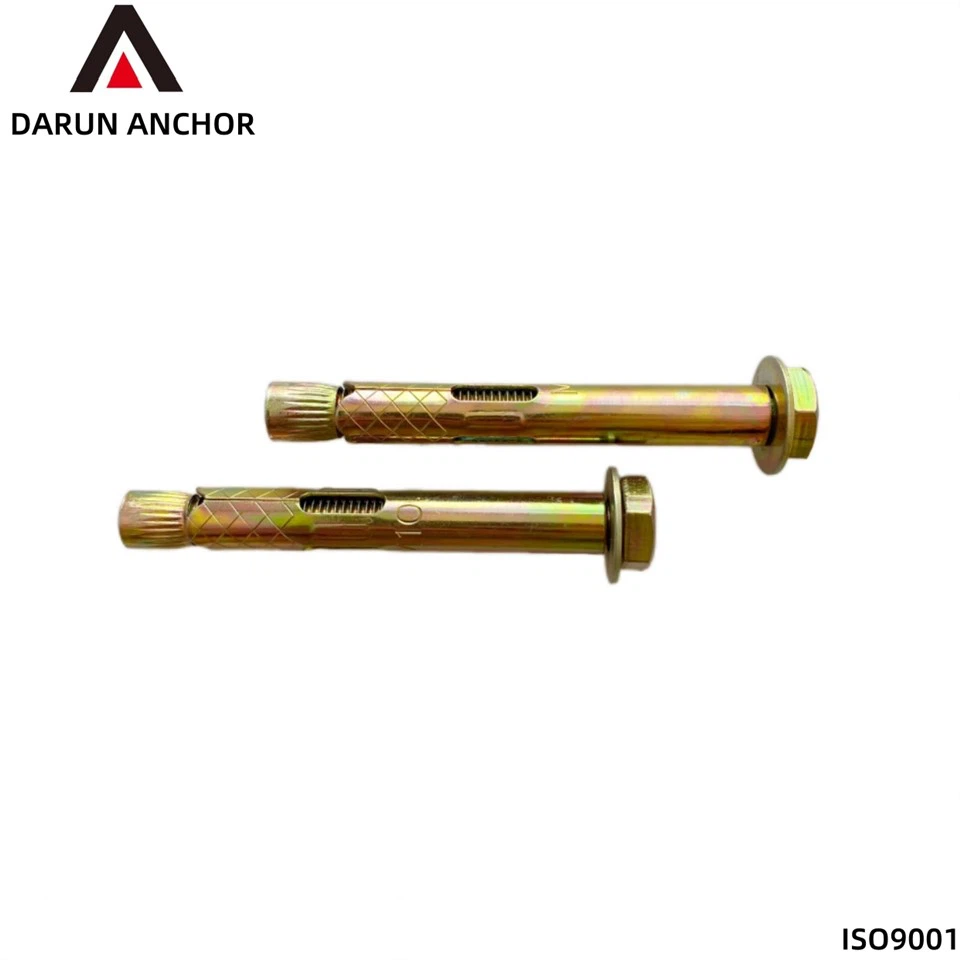
Considered by many in the construction trade and other industries to be one of the most versatile masonry expansion anchors available, sleeve anchors can be used in a variety of base materials, including block, brick, and concrete. Sleeve anchors come in a wide variety of diameters, lengths and head styles, which makes them an excellent fastener solution for light or heavy-duty fastening jobs. They are also pre-assembled and ready for immediate installation.
The anchor sleeve is constructed of high-quality steel components. Each part has zinc plating and comes pre-assembled in a ready-to-use anchor. The anchor consists of a threaded stud that has an outwardly flared, cone-shaped end. The tubular expander sleeve is assembled over the stud and pushed against the tiny diameter of the cone. The washer and hex nut assembled on the stud complete the anchor, which functions based on a true expansion principle: By tightening the nut, it pulls the cone-shaped stud end into the expander sleeve. This process wedges the anchor and locks it into the base material.
The company started to set foot in the fastener industry in 1999, mainly engaged in expansion bolt products. In 2005, the company built its own factory building, covering an area of about 1,000 square meters, and put into operation the first batch of expansion bolt production equipment, and Taihang standard parts were formally established. In 2010, the company's Taihang series of brand products have been sold all over the country, with partners in major cities, and the sales network has begun to take shape. In the same year, the company developed and established a branch factory, and Shuanggu Fastener Factory was established. In 2015, the company developed rapidly, and built a new factory of 15,000 square meters in Mingyang Village Industrial Zone, added more than 60 sets of equipment, integrated production resources, and established Handan Darun Fastener Manufacturing Co., Ltd.

FAQ
As one of the leading sleeve anchor manufacturers in China, we warmly welcome you to buy cheap sleeve anchor made in China here from our factory. All expansion bolt products are with high quality and low price.