

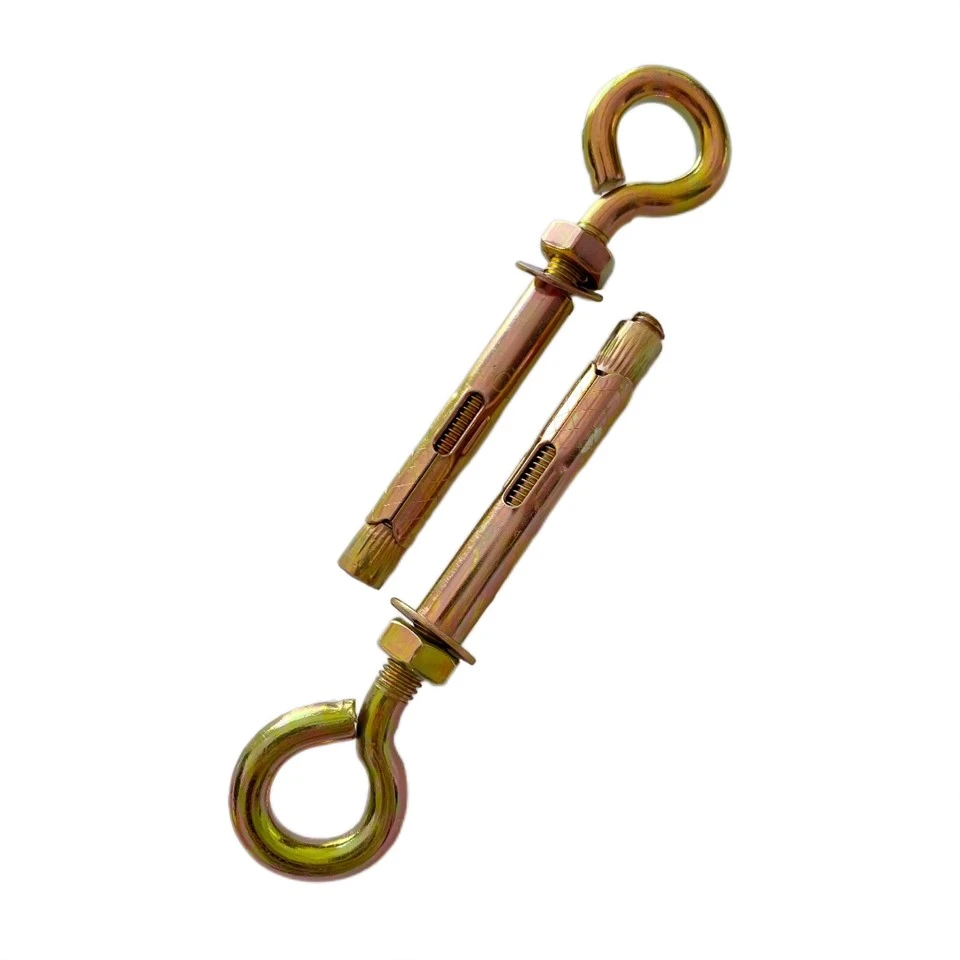
What is Expansion Hook Bolt
An expansion bolt is a type of fastener that consists of a long metal rod with a clip at one end and threads at the other. It gets its name from the fact that when it is tightened, the clip pushes outward against the wall, forming a tight seal between the fastener and the surface it is attached to. This ensures that whatever is being attached remains securely in place, even under pressure or heavy loads. Expansion bolts come in various sizes and lengths, depending on their intended use. They are available in steel, stainless steel, brass, aluminum, and other metals for increased durability and strength.
Benefits of Expansion Hook Bolt
Strong fixing ability
After the hook expansion bolt is tightened, the expansion tube expands in the hole, generating strong friction with the base material, thus achieving a firm fixation. This enables it to withstand large tensile and shear forces, ensuring the stability of the connection.
Easy installation
The installation process is relatively simple. You only need to drill a hole in the base material, then insert the bolt into the expansion sleeve and tighten the bolt with a wrench. No complicated tools or skills are required, which improves work efficiency.
Wide applicability
It is suitable for base materials of various materials, such as concrete, masonry, wood, etc., and has a wide range of applicability.
Reusable
Some types of hook expansion bolts can be reused, which is simple to disassemble and reduces the cost of use.
Strong bearing capacity
Depending on the specifications, the bearing capacity of hook expansion bolts varies. For example, some specifications of expansion bolts can bear hundreds of kilograms per single load, meeting the needs of different occasions.


Why Choose Us
Professional team
We have a team of skilled and experienced professionals who are well-versed in the latest technology and industry standards. Our team is dedicated to ensuring that our customers get the best service and support possible.
Competitive prices
We offer our products at competitive prices, making them affordable for our customers. We believe that high-quality products should not come at a premium, and we strive to make our products accessible to all.
Efficient and convenient
The company has established marketing networks around the world to provide high-quality services to customers in an efficient and convenient manner.
Quality assurance
In terms of quality assurance, the company strictly follows the standards and norms of the industry quality system. Adopt industry-leading testing equipment to ensure product quality and good reputation.
High quality products
We always put customer needs and expectations in the first place, refine on, continuous improvement, to seek every opportunity to do better, to provide customers with their expectations of quality products, to provide customers with the most satisfactory service at anytime.
Customer satisfaction
Providing after-sales services can enhance customer satisfaction by ensuring that customers' needs are met even after the purchase. This can lead to increased customer loyalty and positive word-of-mouth referrals.
Types of Expansion Bolts
Wedge-Type Expansion Bolts
Similar to wedge anchors, these utilize a slotted sleeve and a separate tapered wedge. Tightening the bolt drives the wedge deeper, forcing the sleeve to expand and creating friction within the hole.
Sleeve-Type Expansion Bolts
These function similarly to sleeve anchors as well. They use a hollow sleeve with a separate wedge or sleeve segment inside. Tightening the bolt expands this inner component, generating friction between the anchor and the surrounding material.
Hammer Drill Expansion Bolts
Designed specifically for use with a hammer drill, these anchors feature a threaded section that expands as the bolt is driven in with a hammering action. This hammering action forces the threaded section to expand and grip the inner wall of the drilled hole.
How to Use Expansion Bolts
Determine what size expansion bolt is required for your application. A common installation of securing the metal legs of a machine to a concrete floor, for example, might require one expansion bolt per leg, with each expansion bolt 3/8 inch wide by 3 inches long.
Mark the location of the expansion bolt locations on the floor--this is where the bolt will be secured to the floor. Most heavy duty machines have holes pre-drilled in their feet (legs) for just this purpose. Mark the location of all anchors on the concrete at one time with a marker, so that they are all aligned correctly relative to one another.
Drill the proper size and depth hole for each anchor. The correct size of hole will be supplied by the manufacturer of the anchor bolt, usually labeled right on the box. A rule of thumb is that for a 1/4 inch anchor, use a 1/2 inch drill bit; for a 3/8 inch anchor, use a 5/8 inch drill bit, etc. Depth of the hole is determined by making sure the nut can attach to the bolt (anchor) with enough threading remaining so that it can be torqued sufficiently (usually two complete 360 degree turns of the nut).
Insert the anchor into the hole. Make sure the anchor is resting at the very bottom of the pre-drilled hole before proceeding. Gently tap the anchor (using a hammer) until you are sure it is in its proper position. Remove the nut from the anchor. Next, insert the anchor tool onto the top of the buried anchor (the tool will be included with the anchor(s) kit). Strike the anchor tool firmly three or four times, which will expand the anchor sleeve enough to allow the expansion process to begin once the nut is tightened.
Insert the bolt through the device being secured and then into the anchor (which is still buried). Tighten the nut to the desired amount of torque, or until it is tight if no torque specifications are available.
Key Differences Between Anchor Bolts and Expansion Bolts
While all expansion bolts are anchor bolts, not all anchor bolts are expansion bolts. Here’s a table summarizing the key differences:
|
Feature |
Expansion Bolts |
Anchor Bolts (General) |
|
Type |
Specific type of anchor bolt |
Broad category encompassing various designs |
|
Mechanism |
Relies on friction created by expansion |
Can utilize friction (expansion), adhesion (chemical anchors), or a combination |
|
Installation |
Requires a pre-drilled hole and tightening of bolt/screw |
Installation method varies depending on the specific type of anchor |
|
Holding Capacity |
Varies depending on type and size, generally good for moderate to high loads |
Holding capacity varies widely depending on type, material, and installation |
|
Applications |
Suitable for concrete, brick, and some masonry applications |
Suitable for various base materials including concrete, brick, masonry |
Production Process of Expansion Bolts
The production process of expansion bolts is generally divided into four steps: selection of raw materials, processing, heat treatment and surface treatment.
Selection of raw materials
The main raw materials of expansion bolts include high-strength steel and hardened steel wire. In order to ensure the performance and quality of expansion bolts, the material selection must comply with relevant national standards, and strict quality control must be carried out during the production process.
Processing
The processing process of expansion bolts adopts advanced cold drawing process, which can make the steel produce cold working hardening effect in continuous stretching, and improve the strength and hardness of steel. In addition, the expansion bolts must be cut and processed to form a certain profile and texture during the processing process for subsequent heat treatment.
Heat treatment
The heat treatment of expansion bolts is to improve their hardness and strength, usually using quenching and tempering processes. Among them, quenching can increase the hardness and strength of expansion bolts, while tempering can eliminate the internal stress that may occur during quenching, and improve the plasticity and toughness of expansion bolts.
Surface treatment
The surface treatment of expansion bolts is to improve their corrosion resistance and aesthetics, as well as to increase their friction with concrete. Generally, galvanizing, hot-dip galvanizing, spraying and other methods are used to form a protective layer to ensure that the expansion bolts are not easy to rust and damage during long-term use.
How to Choose the Right Expansion Bolt
Choosing the right expansion bolt requires considering the following key factors:
Load-bearing weight
First, it is necessary to determine the weight of the object to be fixed. Heavier objects require expansion bolts with larger diameters, longer lengths, and higher material strength to provide sufficient support.
Installation substrate
Consider what substrate the expansion bolt will be installed on, such as concrete, brick, wood, etc. Different substrates have different grips on expansion bolts. Concrete usually provides a better fixing effect, while on more fragile substrates such as hollow bricks, it is necessary to choose specially designed expansion bolts or add auxiliary fixing measures.
Installation environment
If the installation environment is humid, chemically corrosive, etc., corrosion-resistant materials such as stainless steel expansion bolts should be selected.
Bolt length
The bolt length should ensure that after installation, the expansion part can be fully embedded in the substrate and there is enough threaded part for tightening the nut. Generally speaking, the bolt length should be at least equal to the depth of the mounting hole plus the length of the thread that needs to be exposed.
Bolt diameter
The larger the diameter, the higher the load-bearing capacity is generally. But you should also choose according to the size of the installation hole and actual needs to avoid being too large or too small.
Brand and quality
Choose expansion bolts of well-known brands and reliable quality to ensure their performance and safety.
Applications of Expansion Bolts
Expansion bolts are commonly used in a wide range of applications where a secure anchor point is required. Some of the most common uses include:
Structural Anchorage
In construction projects, expansion bolts are used to anchor steel beams, columns, and other structural elements to concrete foundations. They provide a strong and reliable connection that ensures the structural integrity of the building.
Exterior Installations
For outdoor installations such as signboards, handrails, and fencing, expansion bolts offer a secure way to attach the fixtures to concrete or masonry walls.
Interior Renovations
During home or office renovations, expansion bolts can be used to mount shelves, cabinets, and other heavy furniture to concrete floors or walls.
Machine and Equipment Mounting
In industrial settings, expansion bolts are often used to mount heavy machinery and equipment to concrete floors.
1. Determine the model of the expansion bolt and the diameter of the hole to be installed. When installing, it should be noted that the diameter of the hole cannot be less than the maximum diameter of the expansion sleeve, otherwise the preload force cannot be generated.
2. Drilling: Drill a hole on the component, and the depth and diameter of the hole should meet the requirements of the drawing.
3. Clean the hole wall: Use a vacuum cleaner to remove debris in and around the hole to ensure that the hole is clean.
4. Install the expansion bolt and expansion sleeve in the hole: Insert the expansion sleeve into the hole, plug the bolt inside, and use force to knock the tail of the bolt to connect it with the embedded expansion sleeve.
5. Rotate the bolt: Use a torque wrench or a manual wrench. When the bolt is rotated clockwise to the predetermined torque, the bolt expands in the expansion sleeve and generates preload force to connect the component.
The company started to set foot in the fastener industry in 1999, mainly engaged in expansion bolt products. In 2005, the company built its own factory building, covering an area of about 1,000 square meters, and put into operation the first batch of expansion bolt production equipment, and Taihang standard parts were formally established. In 2010, the company's Taihang series of brand products have been sold all over the country, with partners in major cities, and the sales network has begun to take shape. In the same year, the company developed and established a branch factory, and Shuanggu Fastener Factory was established. In 2015, the company developed rapidly, and built a new factory of 15,000 square meters in Mingyang Village Industrial Zone, added more than 60 sets of equipment, integrated production resources, and established Handan Darun Fastener Manufacturing Co., Ltd.

FAQ
As one of the leading expansion hook bolt manufacturers in China, we warmly welcome you to buy cheap expansion hook bolt made in China here from our factory. All expansion bolt products are with high quality and low price.