

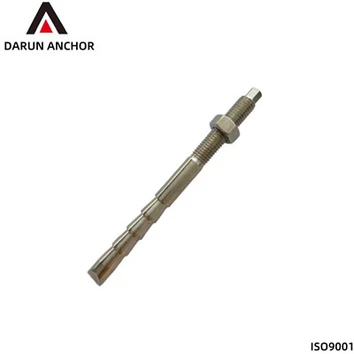
What is Stainless Steel Chemical Anchor
The shield anchor is a three-way expansion shield suitable for use in brick and concrete. The thick walls of the expanders give the anchor its exceptional grip and allow it to cater for oversized holes caused by powerful drills in weaker materials such as brickwork.
Benefits of Stainless Steel Chemical Anchor
Strong performance
Chemical anchor bolt can provide strong fixation force, can firmly fix objects in concrete, brick walls and other substrates. They can withstand a large amount of tension, shear and torque, providing a lasting fixing effect.
Strong adaptability
Chemical anchor bolt is suitable for all kinds of substrates, such as concrete, brick wall, stone and so on. They can form reliable bonding on different substrate surfaces and are suitable for different application scenarios.
Simple construction
Compared with the traditional mechanical anchor bolt, the construction of chemical anchor bolt is more simple. The chemical anchor bolt can be fixed simply by injecting the chemical anchor bolt into the pre-drilled hole and waiting for a certain period of time for the chemical anchor bolt to solidify.
High seismic performance
Chemical anchor bolt has good seismic performance and can withstand external impact forces such as earthquake. This makes them widely used in buildings and structural projects that require anti-seismic requirements.
Corrosion resistance
Chemical anchor bolts are usually made of corrosion resistant materials, such as stainless steel or acid and alkali resistant materials. This enables them to be used in harsh environments for a long time and has good weather resistance and corrosion resistance.
Good concealment
The chemical anchor bolt usually does not protrude on the surface of the substrate after being fixed, which makes the fixed connection more beautiful and reduces the impact on the appearance of the building.


Why Choose Us
Professional team
We have a team of skilled and experienced professionals who are well-versed in the latest technology and industry standards. Our team is dedicated to ensuring that our customers get the best service and support possible.
Competitive prices
We offer our products at competitive prices, making them affordable for our customers. We believe that high-quality products should not come at a premium, and we strive to make our products accessible to all.
Efficient and convenient
The company has established marketing networks around the world to provide high-quality services to customers in an efficient and convenient manner.
Quality assurance
In terms of quality assurance, the company strictly follows the standards and norms of the industry quality system. Adopt industry-leading testing equipment to ensure product quality and good reputation.
High quality products
We always put customer needs and expectations in the first place, refine on, continuous improvement, to seek every opportunity to do better, to provide customers with their expectations of quality products, to provide customers with the most satisfactory service at anytime.
Customer satisfaction
Providing after-sales services can enhance customer satisfaction by ensuring that customers' needs are met even after the purchase. This can lead to increased customer loyalty and positive word-of-mouth referrals.
Chemical Anchor Classification
Mechanical chemical anchor
Mechanical chemical anchor is an anchoring method that can be used for concrete, gypsum board, and fiber cement board. The skeleton material of mechanical chemical anchor is high-strength stainless steel, which reacts chemically with the chemical resin on the surface of concrete, gypsum board, and fiber cement board. The anchoring effect is higher than that of expanded concrete.
There are many types of mechanical chemical anchors, and there are many models and specifications. Common mechanical chemical anchors include M6, M8, M10 and other models, with lengths ranging from 40mm to 250mm. The specific parameters depend on the use occasion and load requirements.
Expansion chemical anchor
Expansion chemical anchor is an anchoring method that can be used for concrete, gypsum board, and fiber cement board. Expansion chemical anchor uses special chemicals to react chemically with the surface of concrete, gypsum board, and fiber cement board on the base surface to generate a highly effective shear-resistant material bond. When using, drill a hole first, then insert the expansion chemical anchor into the hole and inject chemicals to expand it to achieve the anchoring effect.
There are not many types of expansion chemical anchors, and the common ones are M8, M10, M12 and other models. The length is usually 80mm to 150mm, and the specific parameters need to be determined according to the use occasion and load requirements.
Diameter expansion chemical anchor
The diameter expansion chemical anchor is a new type of chemical anchor, which has more advantages than the previous two. It is fixed on the base surface such as concrete, gypsum board, fiber cement board, etc. by diameter expansion, and has the characteristics of high bearing capacity and high shear resistance. The diameter expansion chemical anchor has the characteristics of fast, safe, and economical, and is suitable for construction and engineering.
Common diameter expansion chemical anchors include M16, M20, M24 and other models. The length ranges from 80mm to 250mm, and the specific parameters also need to be determined according to the use occasion and load requirements.
Stainless Steel Chemical Anchor Market Overview
The Stainless Steel Chemical Anchor Market size is expected to develop revenue and exponential market growth at a remarkable CAGR during the forecast period from 2023–2030. The growth of the market can be attributed to the increasing demand for Stainless Steel Chemical Anchor owning to the Architecture, Highway, Bridge, Other Applications across the global level. The report provides insights regarding the lucrative opportunities in the Chemical Sticky Anchor Market at the country level. The report also includes a precise cost, segments, trends, region, and commercial development of the major key players globally for the projected period.
The Stainless Steel Chemical Anchor Market report represents gathered information about a market within an industry or various industries. The Stainless Steel Chemical Anchor Market report includes analysis in terms of both quantitative and qualitative data with a forecast period of the report extending from 2023 to 2030. The report is prepared to take into consideration various factors such as Product pricing, Product or services penetration at both country and regional levels, Country GDP, market dynamics of parent market & child markets, End application industries, major players, consumer buying behavior, economic, political, social scenarios of countries, many others. The report is divided into various segments to offer a detailed analysis of the market from every possible aspect of the market.
The overall report focuses on primary sections such as – market segments, market outlook, competitive landscape, and company profiles. The segments provide details in terms of various perspectives such as end-use industry, product or service type, and any other relevant segmentation as per the market' s current scenario which includes various aspects to perform further marketing activity. The market outlook section gives a detailed analysis of market evolution, growth drivers, restraints, opportunities, and challenges, Porter' s 5 Force' s Framework, macroeconomic analysis, value chain analysis and pricing analysis that directly shape the market at present and over the forecasted period. The drivers and restraints cover the internal factors of the market whereas opportunities and challenges are the external factors that are affecting the market. The market outlook section also gives an indication of the trends influencing new business development and investment opportunities.

1. Drill the Surface
Start by drilling the surface where you want to place the chemical anchor. Make sure that you choose the right chemical anchor for the material you are using.
2. Clean the Drill Hole
After drilling, it is essential to clean out any residue to ensure good adhesion of the resin. Use a Chefix steel brush and a blow pump for this step.
3. Apply the Resin
Depending on the viscosity of the resin, use a lightweight or professional dispensing tool, and discard the first 5 to 10 centimetres of the mixture until it has a uniform colour and texture.
Place the appropriate plug in the drilled hole to enhance fixation. For hollow materials, use a nylon sleeve plug to help distribute the resin. For solid materials, use an internal threaded sleeve, which is ideal for multiple construction applications.
4. Insert the Stud or Fastener
Once the resin has been applied, insert the chosen fastener (such as a screw, rod or stud) by turning it slightly to ensure proper adherence.
Please note that the resin will start to set quickly, so it is essential to insert the fastener immediately after filling the hole.
5. Allow for cure time
Each type of resin has a specific cure time, so it is important to read the manufacturer's instructions carefully and adhere to the specified time to ensure optimum performance.
Behavior of Chemical Anchors Installed in Different Kinds of Concrete
Chemical anchors are widely used in additional installations of construction irons, repair and reinforcement work. Due to the increasing diversity of materials and the improved awareness of waste products, it has become possible to produce different kinds of concrete, with various properties. In this study, class B420C ribbed bars with 16 mm diameter, were installed in four different concretes by using four different chemical adhesives, and a tensile force was applied. The stiffness, displacement ductility ratio, energy-dissipation capability and tensile force values were determined and the failure modes were interpreted from the load-displacement curves, obtained as a result of the experiments. It was found that the tensile force and energy-dissipation capacity, had increased as a result of installing anchor and applying a tensile force to the concrete, that was obtained by adding admixture materials, to the reference concrete. In the analytical part of the study, the formulation provided in ACI 318 was used, capacity and design strengths were identified, and their safety levels were determined in comparison with the test results.
Stainless Steel Chemical Anchor Material
Carbon steel
Carbon steel is a common chemical anchor material with high strength and corrosion resistance. It can be used in some occasions where strength requirements are not high.
Stainless steel
Stainless steel chemical anchors have good corrosion resistance and corrosion resistance, and are suitable for harsh climate environments such as oceans and coasts.
Aluminum alloy
Aluminum alloy chemical anchors have low density and high strength, and are suitable for lightweight building structures such as concrete and brick walls.
Silicate
Silicate chemical anchors have relatively high strength and tensile properties, and are suitable for materials such as concrete, natural stone and steel plates.
Sealant
Sealant chemical anchors have good corrosion resistance and high temperature resistance, and are suitable for environments with high corrosion resistance requirements.
Polyamide resin
Polyamide resin chemical anchors can be used on various types of substrates and have strong seismic and shear resistance.
Chemical Anchor Quality Requirements And Control
It is best to use a drill bit that matches the anchor bolt when drilling, and not damage the steel bar.
Before construction, the anchor bolt must be tested for the mechanical properties of the material, and can be used on site only after the test is qualified.
In site construction, a test to determine the application conditions of anchor bolts should be done to fully inspect the bearing capacity. The test is not only carried out in low-strength concrete, but also in high-strength concrete. In the test, the allowable load, the corresponding spacing, and the thickness of the margin members are embedded in accordance with the manufacturer's instructions. The test adopts axial tension, shear and combined tension and shear to determine the influence of load direction on bearing capacity.
The dust and floating dust in the hole must be cleaned up when cleaning the hole.
When the medicine tube is applied in winter, it should be insulated in advance to ensure that the medicine tube has sufficient fluidity when inserted into the drill hole (when the hand is warm, the resin flows like honey).
The screw must be screwed in with an electric drill, not directly knocked in.
There must be no water in the borehole.
Carbon Steel or Stainless Steel for Chemical Anchors
Different compositional elements
Carbon steel is steel with a certain proportion of carbon elements added to iron. Its advantage is that the hardness can be adjusted by heat treatment as needed, but it is prone to rust when exposed to a humid environment for a long time.
Stainless steel is steel with a certain proportion of elements such as chromium, manganese, nickel, and molybdenum added to iron. Its advantage is that the material is not easy to rust under normal circumstances, has good resistance to low temperatures, acids and alkalis, aging, and heat, and is non-creeping at room temperature, with stable long-term load in a humid environment. However, its hardness can only be annealed and not quenched by heat treatment, and the adjustable range is narrow.
Different costs
In terms of cost, carbon steel anchors are relatively more economical than stainless steel anchors, which are more expensive. However, compared to stainless steel anchors, carbon steel is more prone to rust.
Different coatings
Carbon steel screws are generally divided into cold galvanized screws and hot-dip galvanized screws. In terms of appearance color, cold galvanized screws are bright, while hot-dip galvanized chemical anchors have a deeper, dark gray color. The material grade of carbon steel chemical anchors includes grades 5.8, 8.8, and even 10.9 galvanized, with higher galvanizing grades indicating better quality. The commonly used materials are generally grade 5.8 cold galvanized or grade 8.8 hot-dip galvanized.
The material of stainless steel chemical anchors is divided into 304 stainless steel and 316 stainless steel. 304 stainless steel is a very common type of steel, widely used as a material with iron as the main element and a carbon content generally below 2%, containing other elements. 316 stainless steel chemical anchors, due to the addition of molybdenum, have particularly good corrosion resistance, atmospheric corrosion resistance, and high-temperature strength, and can be used under harsh conditions; they have good work hardening properties.
The company started to set foot in the fastener industry in 1999, mainly engaged in expansion bolt products. In 2005, the company built its own factory building, covering an area of about 1,000 square meters, and put into operation the first batch of expansion bolt production equipment, and Taihang standard parts were formally established. In 2010, the company's Taihang series of brand products have been sold all over the country, with partners in major cities, and the sales network has begun to take shape. In the same year, the company developed and established a branch factory, and Shuanggu Fastener Factory was established. In 2015, the company developed rapidly, and built a new factory of 15,000 square meters in Mingyang Village Industrial Zone, added more than 60 sets of equipment, integrated production resources, and established Handan Darun Fastener Manufacturing Co., Ltd.

FAQ
As one of the leading stainless steel chemical anchor manufacturers in China, we warmly welcome you to buy cheap stainless steel chemical anchor made in China here from our factory. All expansion bolt products are with high quality and low price.